
-
Champagne Henry de Vaugency - Des Amoureux
Regular price From €38,50Regular priceUnit price per -
Champagne Henry de Vaugency - Tradition
Regular price €36,00Regular priceUnit price per -
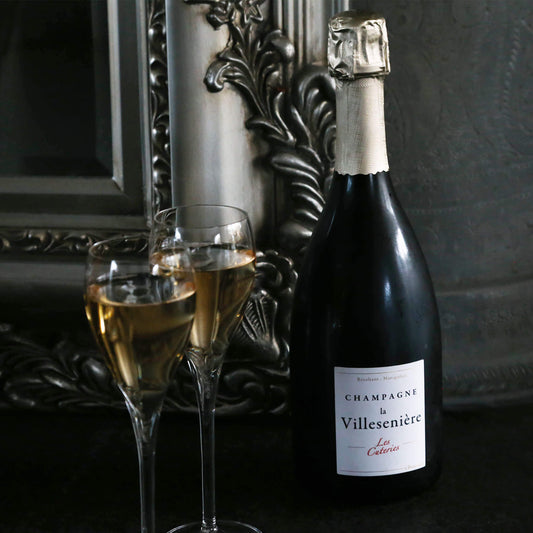
Champagne La Villesenière - Les Cuteries 2016
Regular price €54,00Regular priceUnit price per -
Champagne William Saintot - Blanc De Blancs
Regular price €49,00Regular priceUnit price per -
Champagne Bolieu - Instant B 2014
Regular price €105,00Regular priceUnit price per -
Champagne Bolieu Fleur de Craie
Regular price €55,00Regular priceUnit price per -
Champagne La Villesenière - Les Cuteries 2017
Regular price From €55,00Regular priceUnit price per -
Nieuw
Champagne Simon Rion - Blanc de Blancs 2022
Regular price €54,00Regular priceUnit price per -
Champagne Liébart-Régnier - Blancs de Blanche 2022
Regular price €43,00Regular priceUnit price per -
Champagne Liébart-Régnier - Hortï 2020
Regular price €95,00Regular priceUnit price per -
Champagne Simon Rion - Blanc de Blancs 2021
Regular price €54,00Regular priceUnit price per -
Champagne Liébart-Régnier - L'Enclos 2020
Regular price €78,00Regular priceUnit price per -
Champagne Liébart-Régnier - Coteaux L'Enclos 2022
Regular price €65,00Regular priceUnit price per -
Champagne Bolieu - Carnet de Leone
Regular price €75,00Regular priceUnit price per




What is Blanc de Blancs Champagne?
Blanc de Blancs literally means "white of whites" and refers to Champagne made exclusively from white grapes. Chardonnay is almost always used, as it is the most widely planted white grape in Champagne. This contrasts with Blanc de Noirs, which are made from red grapes such as Pinot Noir and Pinot Meunier. Chardonnay produces a fresh, refined, and mineral-style Champagne. Blanc de Blancs is known for its elegance and finesse and is often aged longer than other Champagnes, developing into a complex wine with deeper aromas and a softer structure.
The taste/aroma profile of Blanc de Blancs Champagne
The flavor profile of Blanc de Blancs varies depending on origin and maturation, but in general, the following characteristics are recognized: Young Blanc de Blancs is fresh, clean, and lively with notes of citrus, green apple, lime, white flowers, and chalky minerality. These champagnes often have high acidity and a fine mousse. After several years of aging, a mature Blanc de Blancs develops aromas of brioche, almond, hazelnut, and dried fruit. The texture becomes creamier and softer, with subtle notes of honey and vanilla. Oude Blanc de Blancs (10+ years maturation) develops deep, complex notes of butter, toast, caramel and roasted nuts, with a subtle oxidative character and a silky mousse.
How does the taste/aroma of Blanc de Blancs change with longer aging?
Blanc de Blancs champagne often has excellent aging potential and can develop beautifully over the years. When matured for 0 to 3 years, the champagne is fresh and crisp with a crisp taste, ideal as an aperitif. With 3 to 7 years of maturation it becomes rounder and more complex, with subtle notes of brioche and almond. When aged for 7+ years it becomes full, rich and creamy with deep, complex notes of butter, honey and dried fruit. Some Blanc de Blancs champagnes, especially the vintage (millesimé) varieties, can age for decades, giving them unique depth and complexity.
When do you drink Blanc de Blancs Champagne?
Blanc de Blancs is extremely versatile and suits different occasions and dishes. It is an excellent choice as an aperitif because of its fresh acidity and fine mousse. With fish dishes, Blanc de Blancs combines excellently with oysters, sushi, sashimi, lobster and crab. Its elegance makes it a good match with light cheeses such as fresh goat's cheese or soft cheeses such as Brie and Camembert. With white meat such as chicken or turkey in combination with a creamy sauce, a lightly aged Blanc de Blancs provides a nice balance.
Our take on Blanc de Blancs Champagne
At Selected by Dronk, we love the diversity within the Blanc de Blancs category. Chardonnay is a grape that can grow on various soils in Champagne, and you can taste that in the different styles. It is always interesting to compare Blanc de Blancs from different regions. In the Côte des Blancs, the most famous region for Blanc de Blancs, limestone soils dominate. This results in tight, mineral champagnes with longevity. Well-known villages include Le Mesnil-sur-Oger, Avize, and Cramant. In the Montagne de Reims, Pinot Noir is mainly planted, but Chardonnay from this region is often fuller and more structured, with riper fruit notes. In the Vallée de la Marne, Blanc de Blancs has a rounder and earthier character due to the mix of clay and sand. An example of this is William Saintot's Blanc de Blancs, which has more body and ripe notes than a classic, straight Blanc de Blancs. In the Côte des Bar, a warmer region, Blanc de Blancs champagnes often become fruitier and more floral due to the influence of the climate. A good example of these differences is Henry de Vaugency Blanc de Blancs versus William Saintot Blanc de Blancs. Henry de Vaugency comes from the Côte des Blancs and is clean, fresh, and mineral, while William Saintot's Blanc de Blancs from the Vallée de la Marne has more earthy and clay notes, resulting in a richer and rounder flavor.
Selected by us. Praised by you.
Hundreds of customers chose our personal selection.